
FIR 360
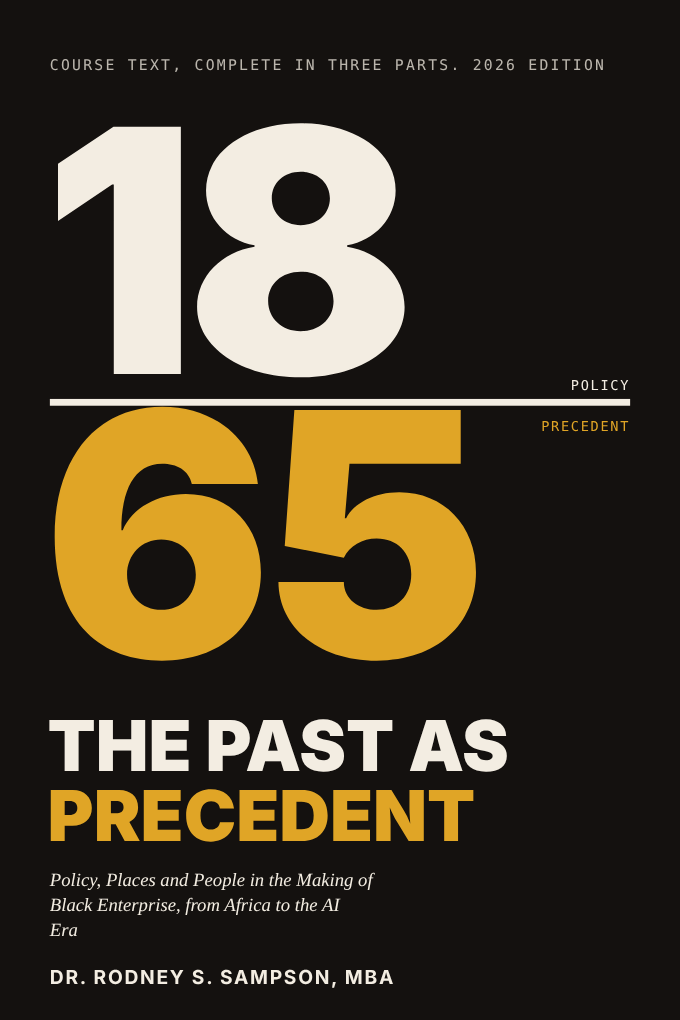
The Past as Precedent
Policy, Places and People in the Making of Black Enterprise, from Africa to the AI Era
Who may own property, sign a contract, borrow, bid on public work and raise capital has always been decided by law. This course reads the economic history of Black Americans through those decisions, the places they shaped and the people who built inside them. Part I covers policy, from the colonial slave codes to the rule changes of 2026. Part II covers places: the free towns, the business districts, what cleared them, and what is being built on the same ground now. Part III covers people, from the traders and scholars of African antiquity to the technology founders of this decade.
- 16
- lessons
- 16
- interactive labs
- 50
- knowledge-check questions
Who it is for
It is written for departments of African American Studies, Political Science, History and Public Policy, and for business schools that want their students to know how the rules of ownership were made. Each part can be taught alone as a unit inside an existing survey, or all three together as a full course.
What is in it
Part I. Policy: The Law of Who Could Own
- Property Without Rights, to 1865What did the law have to forbid in order to keep four million people from owning anything?
- Promises Made and Withdrawn, 1865 to 1900Freedom arrived without land, capital or a bank that held. What would have been different with them?
- Excluded by Design, 1900 to 1964How do you build a middle class for some citizens and not others without writing race into the statute?
- The Opening, 1964 to 1989When government decided to open its own purchasing to Black business, how did it do so, and what did the courts say?
- From Contracts to Capital, and the Turn, 1990 to 2026After the courts narrowed race-conscious programs, what took their place, and what stands today?
Part II. Places: Where It Was Built, and What Became of It
- Free Towns, 1738 to 1910When people who had been property could finally own land, what did they build on it, and what happened to it?
- The Black Wall StreetsHow did communities shut out of white banks, insurers and shops finance entire business districts?
- The Three-Legged Stool: AtlantaWhat does a community need in order to finance its own homes and businesses, and how did Auburn Avenue assemble it?
- Cleared and Crossed, 1949 to 1975Who decided where the highway would go?
- Innovation Districts and Who StaysNew capital is arriving in old neighborhoods. Who will own what it builds?
Part III. People: Who Built, and What They Owned
- Before the AmericasWho were the builders, traders and scholars of the societies from which enslaved people were taken, and how do we know?
- Free and Self-Purchased, 1759 to 1885How did people who were property, or who lived among those who were, acquire property of their own?
- The First Fortunes, 1865 to 1940How did the first generation born in or just after slavery build companies with national reach?
- Inventors and Their Patents, 1821 to the PresentWho invented it, who patented it, and who was paid?
- The Contract Era, 1942 to 2005When public and corporate doors opened, who was ready to walk through them, and who had opened them?
- The Technology Era, 1978 to 2026In an economy built on software and capital, who owns the company on the day it is sold?
A student who finishes can
- Describe the commercial societies of West Africa from which many enslaved people were taken.
- Explain what Special Field Order No. 15 provided and how it was reversed.
- Describe how Jim Crow law and violence constrained Black enterprise after 1896.
- Explain what the Civil Rights Act of 1964 and Executive Order 11246 required of employers and contractors.
For a curriculum committee
- Suggested listing
- FIR 360 (3 credits). Suitable for cross-listing in African American Studies, Political Science, History and Public Policy
- Assumes
- None. Pairs with FIR 201, the gateway course, and with FIR 350, Technology Policy and Infrastructure.
- Pacing
- Sixteen lessons in three parts. In a fifteen-week term, teach Lessons 11 and 12 in one week. Each part can also stand alone as a unit of five or six weeks.
Suggested only. The adopting institution sets numbers, credit and prerequisites.
Formats
- Interactive online text, student edition
- Instructor edition with session plans, slides, test bank, rubrics and pacing guides
- Learning-system package (Common Cartridge)
- Print-ready PDF
- Slide deck for every lesson
By Dr. Rodney S. Sampson, MBA. This course is education. It is not legal, tax, accounting or investment advice.