
FIR 650
Securities Regulation and Capital Formation Policy
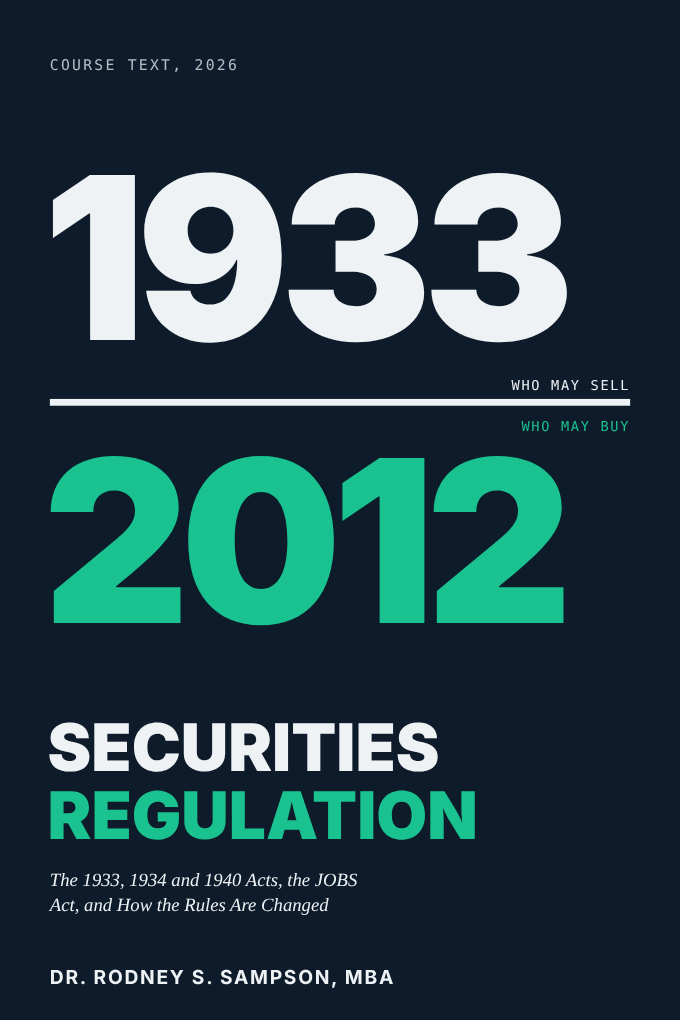
The 1933, 1934 and 1940 Acts, the JOBS Act, and How the Rules Are Changed
The rules that decide who may raise capital and who may invest were written by people, for reasons, and they are being rewritten now. This course teaches the federal securities laws as policy: what each rule requires, whom it protects, whom it burdens and how it is changed. Its final assignment is a comment letter on a real open proposal.
- 12
- lessons
- 12
- interactive labs
- 48
- knowledge-check questions
Who it is for
It is written for graduate students who will work where capital and policy meet: fund managers and founders who want a voice in the rules, staff of agencies and legislatures, advocates, and lawyers in training. It assumes the venture investing course and does not replace a law school course in securities regulation.
What is in it
Part I. The Architecture
- Why Securities Are RegulatedWhy does the law treat selling a share of a business differently from selling anything else, and whom does that protect?
- The 1933 Act: Registration and Its CostWhat does a public offering require, and why have so many companies stopped making one?
- The Exemptions and the Private MarketMost capital is raised without registration. Under what rules, and who is allowed in?
- The Accredited Investor QuestionWho should be allowed to invest in private companies, and should the test be wealth, knowledge or something else?
Part II. The JOBS Act and After
- The JOBS ActHow did a divided Congress pass a major securities law in an election year, and what did it actually change?
- Regulation Crowdfunding as PolicyWhat did it take to let ordinary people buy shares in small companies, and is the balance right?
- Regulation A and the Small Public OfferingCan an offering be open to everyone without the full cost of going public?
- The 1934 Act: Markets and IntermediariesWhat happens after securities are sold: who must report, who may be paid to sell and how can an investor get out?
Part III. Funds, States and the Process
- The 1940 Acts and the Fund RulesWhy may a venture fund have only a hundred investors, and what would change if it could have five hundred?
- The StatesFifty states regulate securities too. What do they add, what do they cost and what can be done there that cannot be done in Washington?
- How the Rules Are MadeWho can change a securities rule, by what process, and how does one person take part?
- The Current Agenda and Your Comment LetterWhat is open now, who is at the table and what will you file?
A student who finishes can
- Name the four federal statutes and what each governs.
- Describe a registration statement and the review process.
- Explain the private offering exemption and why Regulation D was adopted.
- Trace the accredited investor definition from 1982 to the 2020 amendments.
For a curriculum committee
- Suggested listing
- FIR 650, 3 credits (graduate)
- Assumes
- FIR 630 (the venture investing course at graduate level). FIR 640 is recommended. No legal training is assumed.
- Pacing
- Twelve lessons across fifteen weeks. Week 7 is a midterm: a two-sided policy memorandum. Weeks 14 and 15 are mock testimony and the final.
Suggested only. The adopting institution sets numbers, credit and prerequisites.
Formats
- Interactive online text, student edition
- Instructor edition with session plans, slides, test bank, rubrics and pacing guides
- Learning-system package (Common Cartridge)
- Print-ready PDF
- Slide deck for every lesson
By Dr. Rodney S. Sampson, MBA. This course is education. It is not legal, tax, accounting or investment advice.