
FIR 391 · 660
Innovation District Development
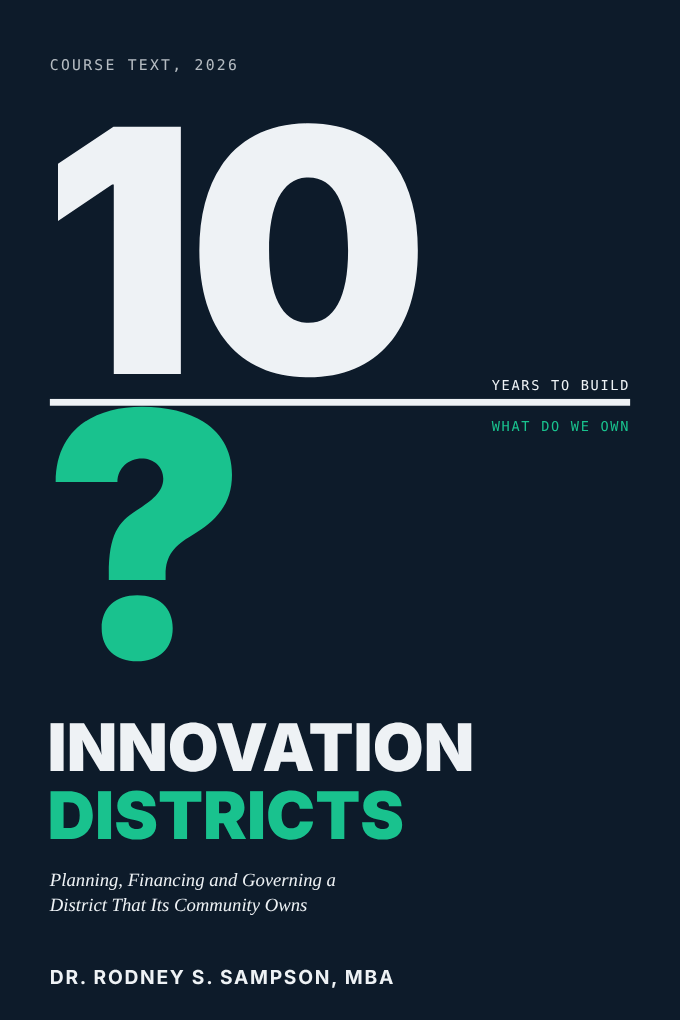
Planning, Financing and Governing a District That Its Community Owns
An innovation district can raise a city's fortunes and leave the neighborhood beside it worse off. This course teaches how districts are planned, financed and governed, and what has to be decided early for residents to stay and to own a share of what is built. It follows one invented district, Model District, from a baseline survey to a ten-year plan.
- 12
- lessons
- 12
- interactive labs
- 48
- knowledge-check questions
Who it is for
It is written for students who will plan, finance, govern or live beside such a place: city and university staff, community organizers, developers, lenders, foundation officers and elected officials. The graduate section produces a commissioned plan for a real city, campus or region.
What is in it
Part I. What a District Is
- From a Room to a DistrictWhat is the difference between a co-working space, a hub, an innovation district and a district its community owns?
- The Record of Innovation DistrictsTwenty years of innovation districts have produced jobs, tax revenue and displacement. Who gained, and was that inevitable?
- Reading the GroundWhat must you know about a place and its people before you propose to change it?
- Anchor InstitutionsWhat can a university or hospital do for the neighborhood beside it, and how do you get it in writing?
Part II. Planning and Financing
- The Master PlanWhat gets built where, in what order, and who decided?
- Programming the DistrictBuildings do not train anyone or start any company. What does, and how is it paid for?
- The Capital StackNo single source pays for a district. Who puts in what, in what order are they repaid, and who has a say?
- Public Tools and IncentivesWhen should a city spend future tax revenue or public land on a district, and on what terms?
Part III. Ownership and Accountability
- Anti-Displacement StructuresIf the district succeeds, how do the people who live there now remain when its benefits arrive?
- Community OwnershipWhat would it take for residents to own a share of the district and gain as it gains?
- Community Benefits Agreements and Large ProjectsA developer needs approvals and a community wants commitments. How is the bargain written so that it holds?
- Governance, Measurement and the Ten-Year PlanWho runs the district, how will anyone know whether it worked, and what will residents own at the end?
A student who finishes can
- Describe the four stages of placemaking in the author's work and what each taught.
- Trace the innovation district from the research park.
- Map land ownership and explain why it governs what follows.
- Define an anchor institution and what it supplies to a district.
For a curriculum committee
- Suggested listing
- FIR 391 (undergraduate) and FIR 660 (graduate), 3 credits
- Assumes
- FIR 201. FIR 330 and FIR 360 are recommended. FIR 350 is useful.
- Pacing
- Twelve lessons across fifteen weeks. Week 7 is a midterm: the baseline, the anchor commitments and the master plan. Weeks 14 and 15 are plan presentations and the final.
Suggested only. The adopting institution sets numbers, credit and prerequisites.
Formats
- Interactive online text, student edition
- Instructor edition with session plans, slides, test bank, rubrics and pacing guides
- Learning-system package (Common Cartridge)
- Print-ready PDF
- Slide deck for every lesson
By Dr. Rodney S. Sampson, MBA. This course is education. It is not legal, tax, accounting or investment advice.